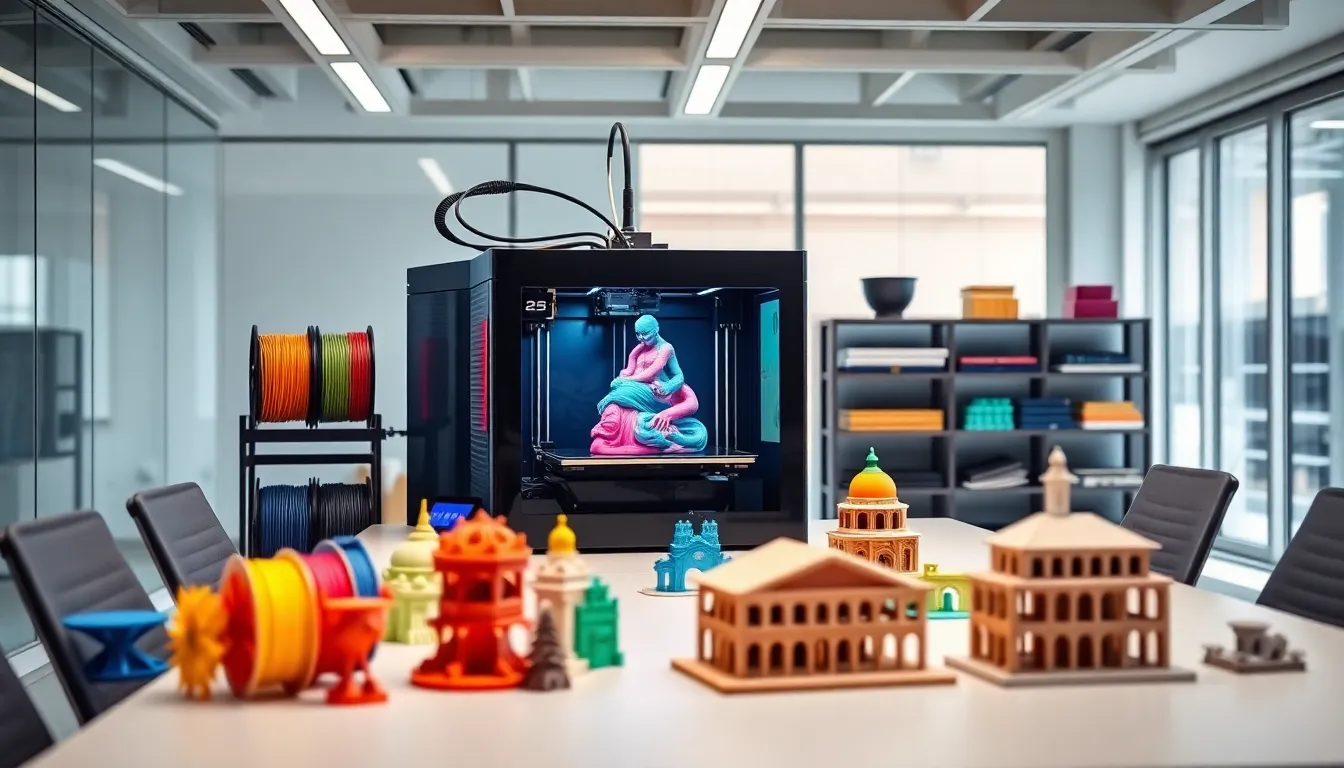
In a world where buildings spring to life faster than a barista can whip up a latte, 3D printing is revolutionizing architectural models. Gone are the days of painstakingly cutting foam board and gluing tiny pieces together. Now, architects can hit “print” and watch their visions materialize right before their eyes. It’s like magic, but with fewer rabbits and more skyscrapers.
Table of Contents
ToggleOverview of 3D Printing Architectural Models
3D printing streamlines the creation of architectural models, revolutionizing how architects visualize projects. This method allows for rapid prototyping, enabling the quick iteration of designs. Architects can generate intricate details quickly and accurately, transforming concepts into tangible models.
Additive manufacturing technologies like Fused Deposition Modeling (FDM) or Stereolithography (SLA) play a crucial role. FDM uses thermoplastic materials, providing durability and cost-effectiveness. SLA offers high precision, making it suitable for complex designs and fine details. Both methods support a variety of materials, including plastics and resins, catering to different project requirements.
Architects leverage 3D printing to enhance communication with clients and stakeholders. Physical models facilitate discussions, allowing clients to better understand spatial concepts and design intent. The feedback loop becomes more efficient with real-world representations, as clients can visualize elements that might be unclear in 2D digital drawings.
Additionally, sustainability considerations encourage the adoption of 3D printing. This technique reduces waste compared to traditional modeling, as it utilizes only the material necessary for the model. Many architects choose biodegradable or recyclable materials, aligning with environmentally responsible practices.
Cost efficiency marks another advantage of 3D printing over conventional methods. The expense associated with tools and labor in traditional modeling decreases significantly. As a result, smaller firms gain access to high-quality models, leveling the playing field in the architectural landscape.
Ultimately, 3D printing fosters innovation and creativity in architectural design, supporting architects in realizing their visions more effectively.
Benefits of 3D Printing in Architecture
3D printing offers several advantages for architectural modeling, revolutionizing the way architects design and communicate their ideas.
Cost Efficiency
Cost efficiency stands out as a significant benefit of 3D printing. Architects can reduce expenses associated with traditional materials and labor. Using 3D printers eliminates the need for extensive handcrafting, which can be labor-intensive and costly. Moreover, as projects scale, the technology allows architects to create multiple prototypes with minimal material waste. This capability enables smaller firms to produce high-quality models without extensive budgets. By lowering costs, 3D printing democratizes architectural design, allowing firms of all sizes to compete effectively.
Time-Saving Advantages
Time-saving advantages frequently accompany 3D printing technology. Architects can output models in hours rather than weeks required for conventional methods. Rapid prototyping facilitates swift iterations of designs, which allows for prompt adjustments based on client feedback. Many architects rely on technologies like Fused Deposition Modeling or Stereolithography to streamline their workflows further. Overall, this efficiency enables firms to meet tight deadlines and respond quickly to market demands, enhancing their competitive edge in the architecture industry.
Common Materials Used in 3D Printing
3D printing utilizes a variety of materials suited for architectural modeling, each offering unique properties and advantages. These materials enhance model quality and cater to specific project requirements.
Plastics
Plastics are the most commonly used materials in 3D printing for architecture. Polylactic acid (PLA) is biodegradable and easy to print, making it ideal for prototypes. Another popular option, Acrylonitrile Butadiene Styrene (ABS), offers durability and impact resistance. These thermoplastics support detailed designs and can be produced quickly, which is crucial for iterative processes. Additionally, nylon and PETG provide flexibility and strength, expanding the range of applications in architectural models.
Metals
Metals are essential for projects requiring robustness and authenticity. Stainless steel, aluminum, and copper are prevalent due to their strength and aesthetic appeal. Stainless steel demonstrates corrosion resistance, while aluminum offers lightweight properties suitable for larger structures. These materials enable the creation of intricate details, making metal 3D printed models valuable for showcasing architectural features. Furthermore, metal 3D printing often employs methods like Direct Metal Laser Sintering (DMLS), ensuring precision in execution.
Composites
Composites combine various materials, enhancing strength and reducing weight. Carbon fiber-reinforced polymers stand out for their remarkable rigidity and lightweight characteristics. These composites allow architects to produce models that mimic real-world material behavior. Other composite alternatives include fiberglass and reinforced resin, which increase durability while maintaining a level of flexibility. Utilizing composites in 3D printing allows for a more comprehensive simulation of architectural elements, aligning closely with intended designs.
Applications of 3D Printing in Architecture
3D printing has various applications in architecture, enhancing creativity and streamlining workflows. The technology offers significant advantages in several areas.
Conceptual Design
Conceptual design benefits greatly from 3D printing by enabling architects to explore complex forms rapidly. Physical models created in this phase help visualize ideas, fostering innovation. Architects can easily tweak designs based on real-world feedback, saving time and resources. Enhanced detail and accuracy bring concepts to life, making it easier to identify design strengths and weaknesses. By encouraging experimentation, this technology transforms abstract ideas into tangible representations.
Prototyping
Prototyping experiences a revolution through 3D printing, allowing architects to test functionality quickly. Rapid prototyping styles facilitate multiple iterations, which are essential for refining designs. Models can undergo modifications without excessive costs, making the process more efficient. This immediate physical presence allows architects and engineers to assess proportions and spatial relationships effectively. Increased precision in prototypes leads to a better understanding of how the final structure will perform and appear.
Client Presentations
Client presentations reach new heights with 3D printed models enhancing the communication of design intent. Clients grasp spatial relationships and materials more effectively through tactile representations. These physical models serve as valuable tools for discussion, allowing clients to provide informed feedback. Architects can illustrate complex aspects in a straightforward manner, fostering clearer understanding. Improved engagement during presentations boosts clients’ confidence in the project’s vision, leading to more productive collaboration.
Future Trends in 3D Printing Architectural Models
3D printing technology continues to evolve, shaping the future of architectural modeling through innovations and sustainability goals.
Innovations in Technology
Advancements in software and hardware enhance the design capabilities of architects. New 3D printers now offer higher resolution, enabling the creation of intricately detailed models. Hybrid printing techniques combine materials, providing designers with unprecedented flexibility. Meanwhile, artificial intelligence and machine learning improve the design process, allowing for automated adjustments and optimizations in real-time. Beyond rapid prototyping, virtual reality integration enables immersive experiences, helping architects visualize spaces before construction begins. As these technologies develop, they create opportunities for more complex and personalized architectural designs.
Sustainability Considerations
Sustainability increasingly influences architectural practices. 3D printing minimizes waste through additive manufacturing, utilizing only the necessary materials for each model. Eco-friendly materials gain popularity as architects seek biodegradable options, reducing their environmental footprint. Companies are experimenting with recycled plastics and sustainable composites, contributing to greener practices. Energy-efficient printing processes also decrease energy consumption, further enhancing sustainability. As awareness of environmental issues grows, architects prioritize sustainable methods, aligning their practices with global ecological goals. This shift not only fosters responsible design but also engages environmentally-conscious clients.
Conclusion
3D printing is undeniably reshaping the landscape of architectural modeling. Its ability to streamline processes and enhance communication between architects and clients is revolutionizing how designs are visualized and refined. The technology not only promotes creativity but also emphasizes sustainability by minimizing waste and encouraging the use of eco-friendly materials.
As advancements continue to emerge, architects are well-positioned to leverage these innovations for improved design capabilities and efficiency. This evolution in architectural modeling is paving the way for a more inclusive and environmentally-conscious future, allowing firms of all sizes to thrive in a competitive industry. The magic of 3D printing is just beginning to unfold, promising exciting possibilities for the architecture world.