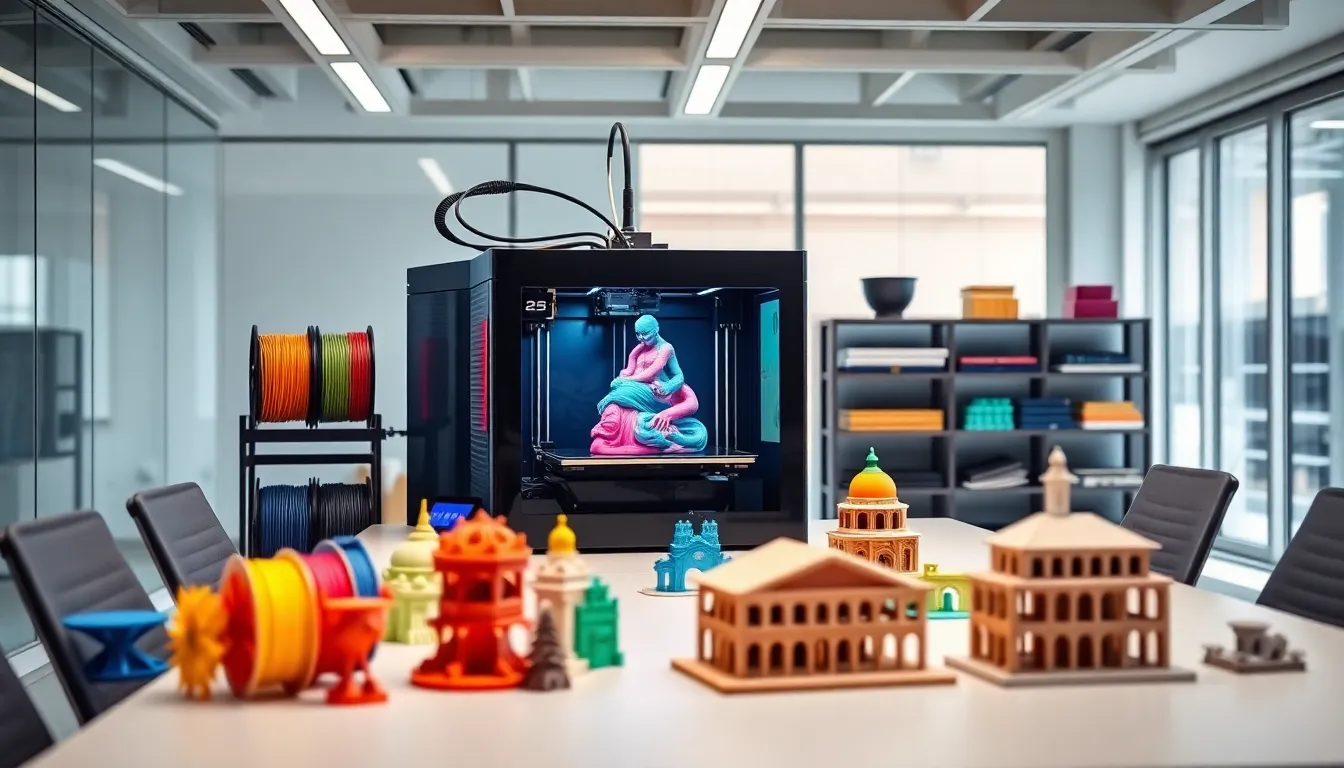
In the world of 3D printing, the extruder is the unsung hero, tirelessly working behind the scenes to turn digital dreams into tangible reality. Think of it as the chef in a high-end restaurant, crafting delicious layers of filament into stunning creations. But not all extruders are created equal. With a variety of types available, choosing the right one can feel like picking a favorite child—impossible and fraught with emotion.
Table of Contents
ToggleOverview of 3D Printer Extruder Types
Many 3D printers feature different types of extruders, each designed for specific applications. Direct drive extruders connect directly to the stepper motor and provide better control of filament feeding. This design generally performs well with flexible filaments due to minimized distance between the drive gears and the hotend.
Bowden extruders, on the other hand, separate the drive motor from the hotend. By using a long PTFE tube to guide filament, this type reduces weight on the print head, allowing for faster print speeds. Users may experience increased retraction issues or require more calibration with flexible materials.
All-metal hotends cater to high-temperature printing needs, capable of handling materials like Nylon or Polycarbonate. These hotends feature a heat break that prevents heat creep, ensuring consistent filament flow. They often pair well with high-performance printers requiring versatile filament options.
Thermoplastic extruders focus on producing parts using thermoplastic materials. Commonly found in FDM printers, these extruders melt filament and deposit layers to create objects accurately. Enthusiasts frequently choose them for their reliability and ease of maintenance.
To sum up, understanding various extruder types helps users select the right one for their printing needs. Each design offers distinct advantages, making it essential to consider factors like print speed, material compatibility, and ease of use when making a decision.
Direct Drive Extruders
Direct drive extruders represent a popular choice for many 3D printing enthusiasts. They feature a design where the extruder is located directly on the print head. This setup allows for precise filament control.
Advantages of Direct Drive Extruders
Direct drive extruders excel in flexibility, making them suitable for a wide range of filament types. They enhance the ability to print with flexible materials, reducing the risk of jamming. A shorter filament path enables quick retraction, which minimizes oozing during printing. Consistent extrusion contributes to better print quality, especially when fine details are critical. Users often notice improved layer adhesion, leading to stronger prints. Direct drive systems generally offer easier tuning, promoting user-friendly adjustments.
Disadvantages of Direct Drive Extruders
Direct drive extruders tend to add weight to the print head, which may affect printing speeds. Increased mass can lead to slower accelerations, impacting overall performance. They require more maintenance due to their exposed position, making regular cleaning necessary. Hotend cooling might face challenges, especially when using high-speed settings. Limited compatibility with certain printer designs can restrict options for some users. Noise levels may increase, with the extruder motor generating more sound during operation.
Bowden Extruders
Bowden extruders are a popular choice in 3D printing due to their unique design. This type of extruder places the motor away from the print head, using a long tube to guide the filament to the nozzle.
Advantages of Bowden Extruders
Bowden extruders offer several benefits that enhance 3D printing performance. They’re lightweight, which reduces the print head’s overall mass and allows for faster print speeds. By minimizing the weight on the moving parts, users often experience smoother acceleration and improved print quality. These extruders also facilitate easy filament changes and maintenance. They generally handle rigid filament types with fewer jams, promoting reliability in printing. Many users appreciate their compatibility with a wider range of hotend designs, allowing for versatility in materials.
Disadvantages of Bowden Extruders
Despite their advantages, Bowden extruders come with specific drawbacks. More calibration may be required for optimal performance, especially with flexible filament types. Users might face challenges with oozing due to longer filament pathways, which can affect print quality. Prints can suffer from uneven extrusion due to the additional length between the drive gear and the nozzle. Moreover, the retraction settings often need precise adjustments to combat stringing. Lastly, these extruders may not provide the same control as direct drive systems, particularly for complex prints.
Multi-Material Extruders
Multi-material extruders enable the simultaneous printing of different filament types or colors. These extruders provide increased design flexibility, allowing for complex objects with varying properties.
Advantages of Multi-Material Extruders
Multi-material extruders enhance creativity through combining materials during printing. They allow for the use of support materials that dissolve, making complex geometries more achievable. Increased color variation is possible, giving users the ability to create visually striking designs. Printing with different materials can improve functionality, such as incorporating flexible parts into rigid structures. Cost-effectiveness comes from reducing material waste since users can utilize leftover filament for new projects.
Disadvantages of Multi-Material Extruders
Multi-material extruders present challenges that users need to consider. Calibration complexity increases due to the need to balance multiple filament types in the same print. Equipment compatibility issues can arise if the printer is not designed to handle multiple materials. Increased maintenance requirements stem from having additional components, which can lead to clogging. Print quality may suffer without proper adjustments, especially if the materials have differing thermal properties.
Comparison of Extruder Types
Direct drive extruders stand out for precise filament control. Their placement on the print head enhances performance, especially with flexible materials. Users benefit from reduced jamming and quicker retraction, leading to improved print quality. Added weight can hinder print speeds, contributing to maintenance challenges. It’s essential to consider compatibility with specific printer designs.
Bowden extruders offer a distinct advantage with their lightweight design. The motor’s location away from the print head increases acceleration and print speeds. Maintenance becomes easier, and filament changes are more seamless. Calibration is more demanding, which can affect print consistency. Users may experience challenges with oozing and uneven extrusion on complex prints.
Multi-material extruders provide versatility for printing with various filament types. Creativity flourishes as users combine materials for unique designs. Enhanced functionality allows for integrating flexible elements into rigid structures. Dissolvable support materials facilitate complex geometry. Calibration complexity rises, necessitating careful attention to equipment compatibility. Additional components lead to higher maintenance needs, impacting overall print quality if materials behave differently under heat.
Comparing these extruder types highlights specific strengths and weaknesses. Direct drive extruders excel with flexible filaments despite added weight. Bowden extruders prioritize speed and maintenance simplicity but require careful calibration. Multi-material extruders amplify design possibilities, though they demand higher maintenance. Choosing the right extruder depends heavily on the desired balance between speed, material compatibility, and ease of use.
Conclusion
Choosing the right extruder type is vital for achieving optimal results in 3D printing. Each type presents unique advantages and challenges that cater to different printing needs. Direct drive extruders offer precision and flexibility while Bowden extruders enhance speed and ease of maintenance. Multi-material extruders open up creative possibilities but require careful calibration and maintenance.
By understanding these differences, users can make informed decisions that align with their specific projects and goals. The right extruder can significantly impact print quality and efficiency, making it a key consideration for both beginners and experienced enthusiasts alike.